Use Cases

For work that's too important to fully automate, and too repetitive to do by hand.

Three firms, three regulated processes, one engine. Every workflow, agent and rule below is read out of a Dave tenant that actually exists.

Join the Waitlist

These three firms are fictional. The workflows are not.

Meridian Capital Group, Northwind Therapeutics and Hartwell & Associates LLP are demonstration companies we invented so we could build something real on top of them. They are not customers, they have no websites, and no part of this page describes work done for a client. What is real is everything underneath: each firm is a seeded Dave tenant with its own workflows, AI agents, roles and runs in flight, and every node, agent, rule and finding below is read straight out of that seed data.

What can you build with Dave?

You can build any process that blends AI and human steps. The three demonstration tenants on this page are seeded examples: a capital markets firm running KYC pre-screening and marketing compliance scanning, a pharmaceutical company running promotional material review behind two human sign-offs, and a law firm rating contracts against its own playbook before a partner ever sees one. Because there is no cap on nodes, a four-step approval and a twelve-step pipeline that generates and deploys a website both run on the same engine.


Are Meridian, Northwind and Hartwell real customers?

No. All three are companies we invented so we could build something real on top of them. None of them is a customer, none has a website, and nothing on this page describes work done for a client. They exist only as three seeded Dave tenants, demo-finserv, demo-pharma and demo-legal. What is real is everything underneath: every workflow, node, routing rule, agent guardrail and run in flight is read straight out of that seed data.

Three firms you can take apart

A capital markets group, a therapeutics company and a commercial law firm. Each one is a seeded Dave tenant with its own workflows, agents, roles and runs. Open any of them and you get the whole graph: every node, every rule, every guardrail written into every agent.

Find the line. Hold it.

Financial services

A capital markets group that builds and operates the settlement, treasury and reporting infrastructure its clients used to build badly in-house.

Compliance is the gate on everything Meridian publishes or opens. Dave runs the screening, the scanning and the drafting, and routes only the risky items to a person.

  • Client Onboarding Compliance Review
  • Marketing Material Compliance Check
  • SEC Filing Analysis
Explore Meridian

Evidence, everywhere it is needed.

Pharmaceutical

A mid-cap therapeutics company running trials and launches across 14 markets, where every piece of content has to survive a regulatory reviewer before anyone outside sees it.

Nothing Northwind publishes reaches a prescriber without passing an AI claims check and two named human sign-offs. Dave is the thing that makes that chain provable rather than promised.

  • Promotional Material MLR Review
  • Regulatory Submission Section Prep
  • Adverse Event Literature Screening
Explore Northwind

Counsel that keeps pace.

Legal

A mid-Atlantic commercial law firm that pairs partner-level judgement with an operations layer most firms its size cannot afford.

A firm this size cannot put a partner on every intake. Dave reads the contract first, rates it against the firm's own playbook, and only a high rating reaches the managing partner.

  • Contract Intake & Risk Review
  • Matter Research Memo
  • Client Engagement Letter Drafting
Explore Hartwell

The same engine, three different jobs

Where they agree is more interesting than where they differ. In all three, the AI produces findings and a rule decides whether a person is needed.

Sector

Meridian

Financial services

Northwind

Pharmaceutical

Hartwell

Legal

What the AI does first

Meridian

Screens a new client for KYC and AML risk

Northwind

Checks promotional claims against the approved label

Hartwell

Rates a contract against the firm's playbook

What decides a human gets involved

Meridian

A risk rating of high on the marketing scan

Northwind

Nothing. Every asset gets two human gates

Hartwell

A risk level of high sends it to a partner instead of an associate

Who signs off

Meridian

Compliance, and the risk officer on reports

Northwind

A medical reviewer, then regulatory affairs

Hartwell

A partner or an associate, depending on the rating

The step people do not expect

Meridian

A live call to the SEC's public EDGAR endpoint mid-workflow

Northwind

An agent voting on another agent's draft before a person sees it

Hartwell

Cite-checking as a workflow step with a vote, not a habit

Is Dave a good fit for agencies and holding companies?

Yes. One Dave deployment can run many isolated, branded workspaces at once: full tenant isolation, per-tenant encryption and branding, and feature flags, with zero cross-tenant leakage. It's literally how voolama runs five brands on a single Dave instance.

Do I need to write code to build a workflow like these?

No. Workflows are built on a visual drag-and-drop canvas: you drag node types from a palette, connect them in the order the work happens, and save. The editor exists precisely so that designing a process does not mean hand-writing a graph definition, which is what keeps it in reach of the people who own the process rather than only the people who write software.

The patterns underneath

Strip the sector away and the same five shapes keep turning up. These are the ones teams put on the canvas first.

Content operations at scale.

Research → draft → review → publish, as one auditable pipeline. AI agents write on the model you pick, human editors approve in a review flyout, and API-call nodes push the finished piece straight into your CMS. Every version tracked; nothing goes live without sign-off. (This site's content runs exactly this way.)

Approval workflows you can defend in an audit.

Trade email threads and 'who approved this?' for structured, logged approval flows: role-based review nodes, voting, full reviewer context, and a complete audit trail, with SOC 2 and GDPR compliance modes for work that's regulated or brand-critical.

AI-assisted research, on tap.

Point agents at a question; they gather, summarize, and structure the answer, then hand it to a human to validate before anyone trusts it. Export to JSON, HTML, or plain text and feed it downstream. A research backlog becomes a button.

Multi-tenant operations for agencies & holding companies.

One deployment, many clients or business units: full tenant isolation, per-tenant branding and encryption, feature flags, white-label from day one. It's literally how voolama runs five brands on a single Dave instance.

Back-office automation with a brain and a brake.

Wire Dave to any REST API (CRM, tickets, billing, webhooks) across 305 endpoints, and gate the steps that move money or carry risk. Automate the repetitive; review the consequential.

The four moves all three firms are made of

Different sectors, different stakes, the same four building blocks on the same engine. Every example below is drawn from one of the three tenants.

  1. 1. Someone starts it

    A User Interaction node collects exactly what the process needs before it can move: the client's jurisdiction at Meridian, the product an asset covers at Northwind, the contract type at Hartwell. Required fields really are required, so a run cannot travel half-briefed.

    Guide: Set up a custom field
  2. 2. An agent does the reading

    The engine calls the agent on the provider and model that agent is pinned to, with retries configured before a person is ever pulled in. Notice what all three are told: the KYC analyst recommends only, the label claims checker never approves, the contract analyst produces findings and no advice.

    Guide: Create an agent
  3. 3. A rule decides whether a person is needed

    Meridian's compliance scan routes only high-risk material to a reviewer. Hartwell's triage sends only high-risk contracts to a partner and everything else to an associate. Northwind's screening escalates only a detected signal. The rest clears itself, by a rule written in advance rather than by whoever is looking.

    Guide: Build your first workflow
  4. 4. A person signs, or sends it back

    A Human Review node assigned to a named role. Approve moves the run on; reject requires a written reason and returns it to a specific earlier node the workflow author chose, which is why Northwind's medical rejection goes back to the author while Meridian's analyst rejection goes back to the agent.

    Guide: Work a task from your inbox

Access mapped to how teams actually work

RoleWhat they can do
AdminFull tenant administration: every permission, unrestricted.
CreateBuild and manage AI agents: prompts, models, configuration.
CurateDesign workflows in the visual editor, the graph itself.
UseRun instances and complete tasks: open assigned work, provide input, approve or reject.
ReportingAnalytics only: run volume, failure rates, latency, and SLA metrics. No edit access.
FinancialBilling and subscription management: seat counts, invoices, and the workspace plan.

What this looks like once it is running

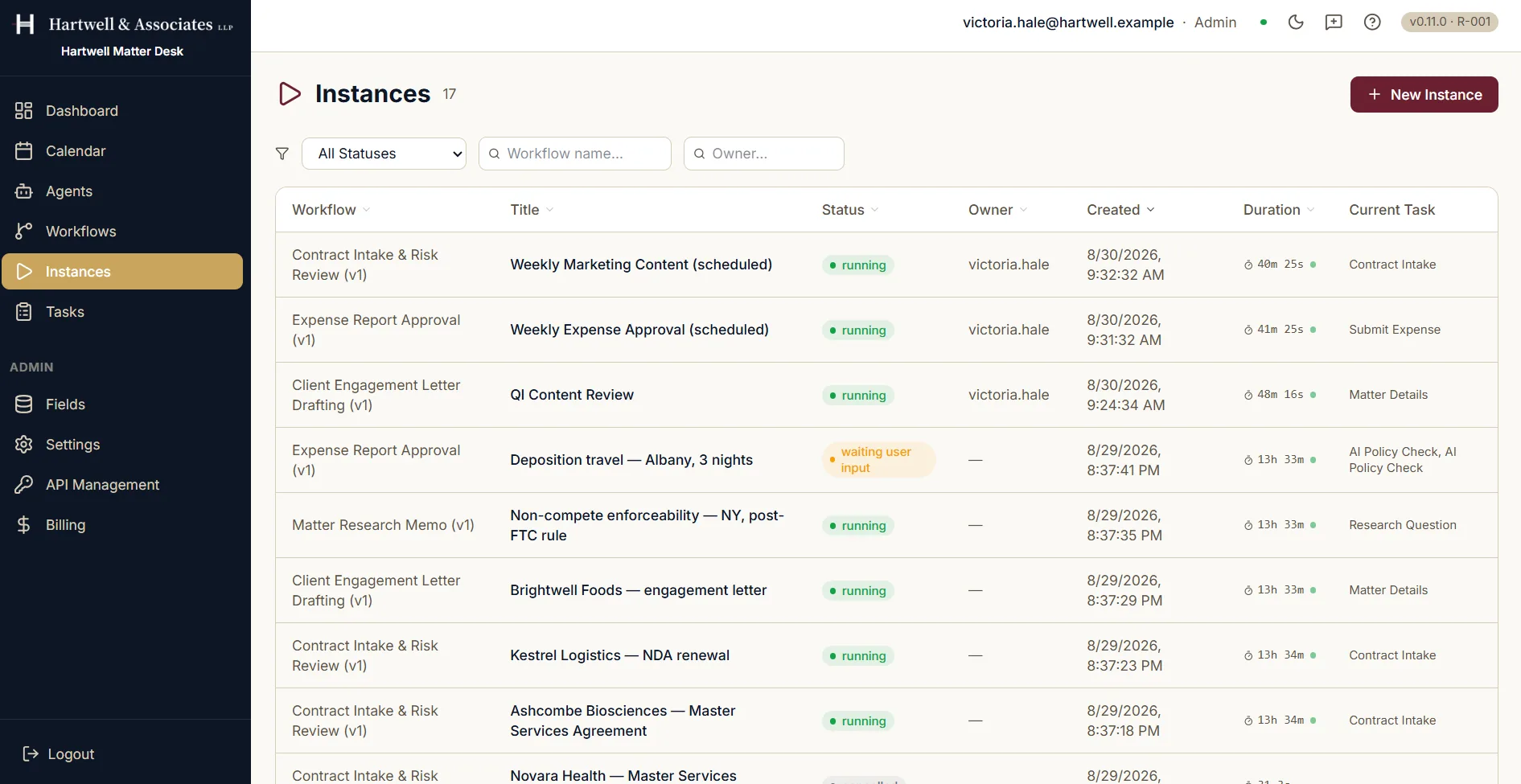
Runs in flight in one of the three demonstration tenants, each showing the step it is waiting on.

The Instances screen listing seventeen runs, with filters for status, workflow name and owner. Each row names its workflow and version, the run's own title, its status, its owner, when it was created, how long it has been going and the step it is currently on. Three scheduled runs at the top are running, minutes old and sitting on Contract Intake, Submit Expense and Matter Details. Below them one run is waiting on user input at an AI Policy Check, several more are running on Contract Intake or Research Question, and one is cancelled.
The Hartwell and Associates demonstration tenant: runs in flight, each showing the step it is waiting on.

Frequently asked questions

What kinds of workflows is Dave best for?

Any process that blends AI and human steps: content drafting and review, structured approvals, AI-assisted research, and back-office automation across your other systems.

Can I run recurring workflows on a schedule?

Yes. An instance can be scheduled from the calendar, triggered via the API, or kicked off manually, and scheduled runs always use the current workflow version.

Can Dave publish results to another system automatically?

Yes. An API Call node can post approved output to a CMS, update a ticket, or send data to another service, all inside the workflow with no middleware.

How does Dave help agencies manage many clients?

Each client or business unit gets a fully isolated workspace with its own branding, encryption keys, and feature flags, and no cross-tenant leakage.

Is there a full audit trail for regulated work?

Yes. Every data mutation and decision is recorded, with SOC 2 and GDPR compliance modes and CSV export for reporting. SOC 2 mode adds read-access logging on sensitive endpoints and recommends a seven-year retention window.

Are the three firms on this page real customers?

No. Meridian Capital Group, Northwind Therapeutics and Hartwell & Associates LLP are fictional companies we invented as demonstration tenants. They are not customers, they have no websites, and none of these pages is a case study. The workflows, agents, roles and runs shown for each one are real seed data from a Dave tenant.

Do I need to write code to build a workflow?

No. The workflow editor is a visual drag-and-drop canvas with a palette of ten node types. You drag nodes onto the canvas, connect them in the order the work happens, and save a version.

Can one AI step check another AI step's work?

Yes. An Agent Review node is an automated quality check: an agent evaluates content against defined criteria and returns a pass or fail, and a fail can send the work back to be redrafted before any person sees it. Two of the three demonstration tenants use one.

Your process is the fourth one.

Whatever it is, it decomposes into the same four moves. Build it on the canvas and see one run end to end.

Use Cases: Content Ops & Approval Workflow Automation | Dave