How It Works

From first login to live AI workflow in minutes. No infrastructure headaches. No month-long implementations. Just a clean, visual process that puts you in control.

Join the Waitlist

1. Configure your agents.

Screens from a demo workspace with example data.

Step 1 of 5, configure your agents. The Agents screen listing four AI agents: Expense Policy Checker, Contract Risk Analyst, Engagement Letter Drafter and Legal Research Assistant. Each row shows the provider and model it is pinned to, all four on the same Anthropic demo provider running claude-sonnet-5, a status of active, a demo tag, and a version count.

1. Configure your agents. Screens from a demo workspace with example data.

How do you build a workflow in Dave?

You build a workflow by dragging nodes onto a visual canvas and connecting them with routing rules: AI agent nodes where you want automation, human review and user interaction nodes where you want oversight, and API Call nodes to reach other systems. There's no limit on the number of nodes, and every save creates a new version you can roll back to.

What node types can a Dave workflow use?

A workflow combines ten node types: Start, End, Agent Interaction, Agent Review, User Interaction, Human Review, API Call, Routing, Safety, and Information. Review nodes produce an approve or reject vote, and a rejected human review requires a written reason before the work moves on.

The End-to-End Process

  1. 1. Configure Your Agents

    Agents are the AI workers inside your workflows. Connect your existing AI provider (OpenAI, Anthropic, Google, Azure, or a self-hosted model) and define what each agent does. Give it a system prompt, pick a model, set its behaviour. Your credentials stay yours. HelloDave never touches your API keys.

    Guide: Create an agent
  2. 2. Build Your Workflow

    Open the visual editor and drag nodes onto the canvas. Connect them with routing rules. Add AI steps, human review points, safety checks, and API calls in whatever order your process demands. There's no limit on nodes. Save at any point and every save creates a new version, so you can always roll back.

    Guide: Build your first workflow
  3. 3. Launch an Instance

    When you're ready to run, create an instance of your workflow. Each instance is a live execution, tracking its own progress, data, and context as it moves through every step. Schedule it from the calendar, trigger it via the API, or kick it off manually. The engine takes it from there.

    Guide: Launch an instance
  4. 4. Handle Tasks

    When a workflow reaches a human step, a task is created and lands in the right person's inbox. They review, approve, reject, or add input, and the workflow continues. Tasks can be assigned to specific users or roles. The first to accept it claims it. Nothing gets lost, nothing waits silently in the background.

    Guide: Work a task from your inbox
  5. 5. Monitor and Report

    Watch instances run in real time. Every action is logged: every agent call, every field change, every human decision. Filter the audit trail, export it as CSV, and track performance across your whole operation. If something goes wrong, you'll know exactly where, when, and why.

    Guide: Watch a run and read its timeline
Running the work

How does someone know a task is waiting for them?

The task lands in their Task Inbox, and Dave emails them. Your workspace sets one rule per event, covering task assigned, instance started, instance completed, instance cancelled and user invited, and chooses who each one reaches: the assignee, whoever started the run, everyone holding a role on it, workspace admins, everyone with a named role, or one specific person. A single noisy approval step can override that rule to stay quiet or notify an audience of its own, without changing anything for your other workflows. Every send is recorded with its status, and a failed one retries automatically for up to 24 hours.
Can I stop a workflow that is already running?

Yes, in two different ways. Pause suspends a running instance without losing its place, and Resume picks it up from exactly where it stopped. Cancel is the permanent one: it ends the run for good, cannot be restarted, and is offered from every state that has not already finished. New instances also start as a draft, so you can confirm you picked the right workflow version before anything executes.

Being told, and being able to stop it

The notification rules on the left, the runs themselves on the right, in a second demonstration workspace that sets its own theme.

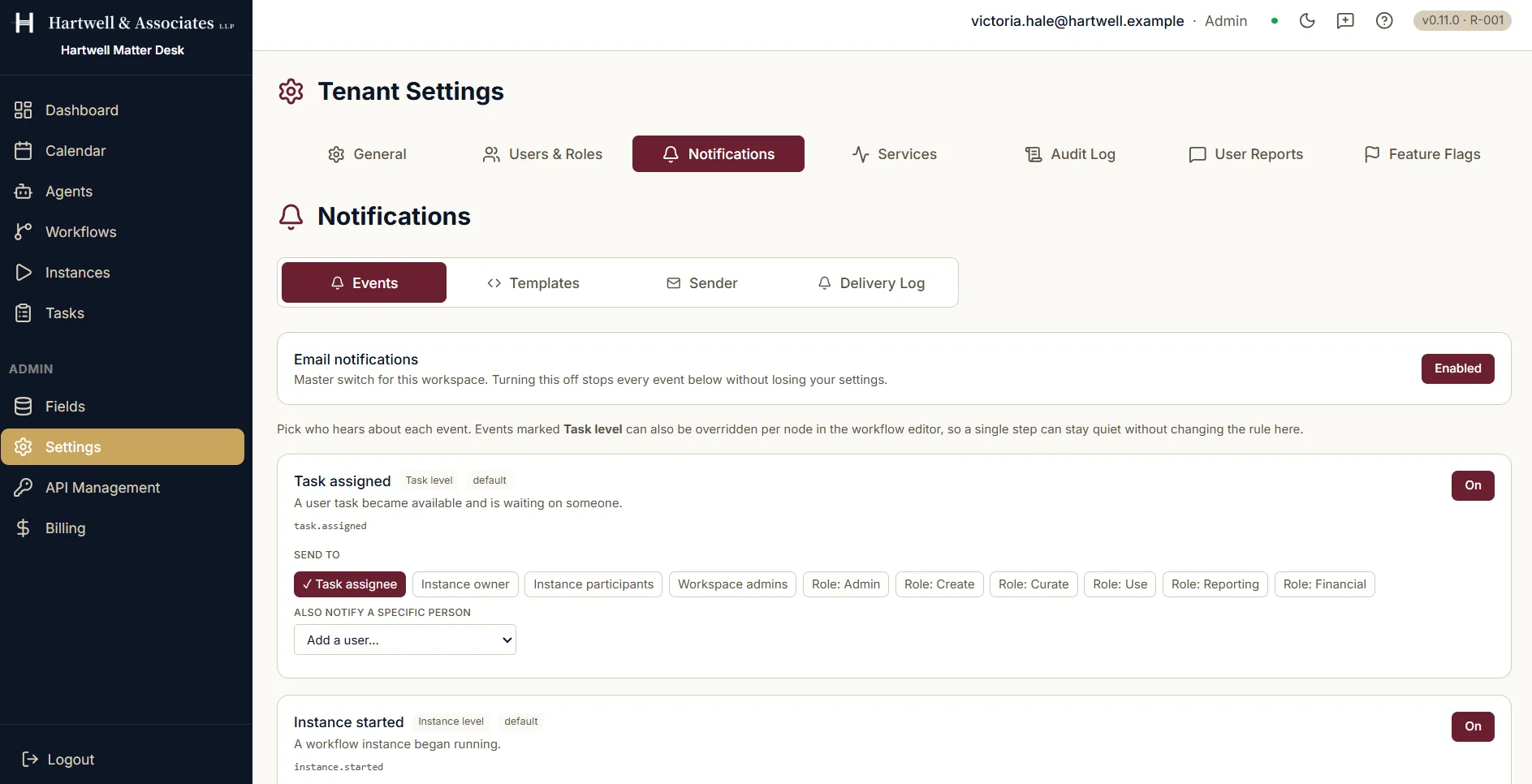
The Notifications tab of Tenant Settings, on its Events sub-tab, with Templates, Sender and Delivery Log alongside. A master email notifications switch is enabled. Below it the Task assigned event, marked task level and default, is switched on and described as a user task becoming available and waiting on someone. Under a Send To label a row of audience chips offers Task assignee, which is ticked, then Instance owner, Instance participants, Workspace admins, and one chip for each of the six roles: Admin, Create, Curate, Use, Reporting and Financial. A dropdown below adds one specific person. The Instance started event follows, also switched on.
One rule per event, and you choose who it reaches. A single noisy step can override the rule without changing anything for your other workflows. Demo workspace with example data.
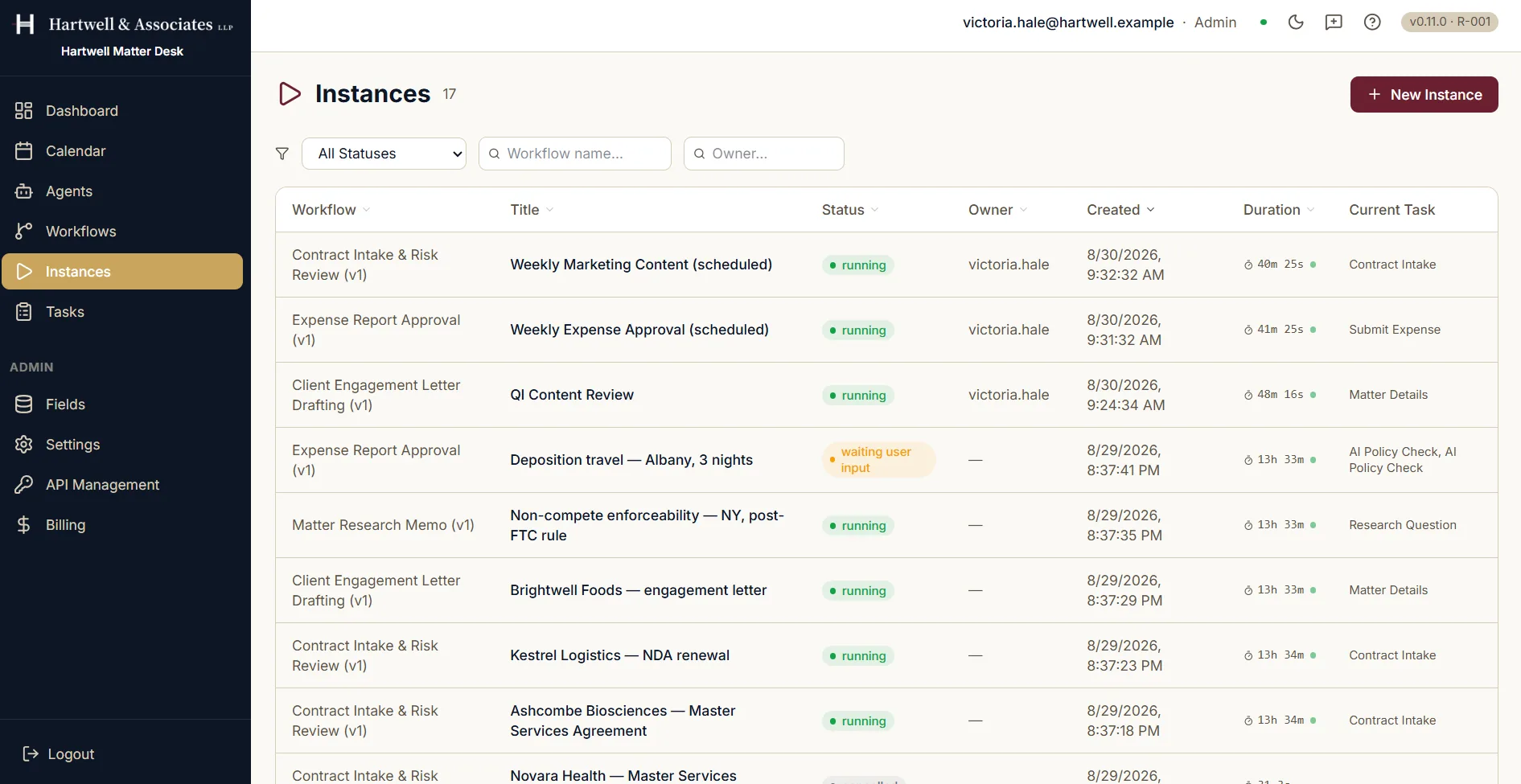
The Instances screen listing seventeen runs, with filters for status, workflow name and owner. Each row names its workflow and version, the run's own title, its status, its owner, when it was created, how long it has been going and the step it is currently on. Three scheduled runs at the top are running, minutes old and sitting on Contract Intake, Submit Expense and Matter Details. Below them one run is waiting on user input at an AI Policy Check, several more are running on Contract Intake or Research Question after about thirteen hours, and one is cancelled.
Every run, its status and the step it is waiting on. Pause holds a run where it is, Resume continues it, and Cancel is permanent. Demo workspace with example data.

Your Keys. Your Data. Always.

Most AI platforms put your data in their cloud and leave you hoping for the best. HelloDave is fully managed (infrastructure, SSL, updates, all handled) but your AI keys and your workflow data stay yours. We never proxy your AI calls or touch your credentials, and every tenant's data is isolated behind its own encrypted vault.

The same three steps, in the product

Design the process, let people and agents work it, then watch the run.

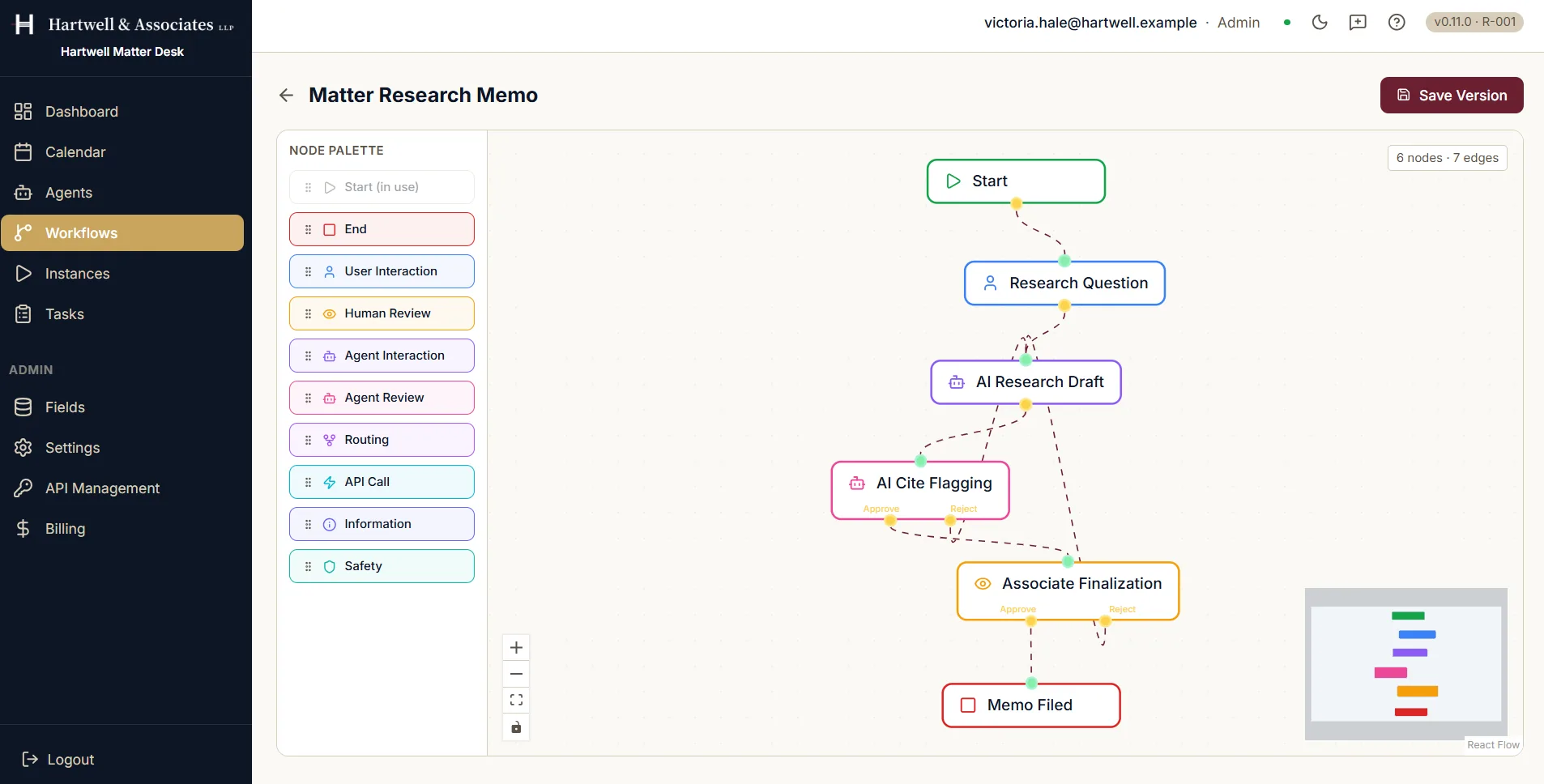
The Dave workflow designer with the Matter Research Memo workflow open on the canvas. A node palette on the left lists Start, marked in use, then End, User Interaction, Human Review, Agent Interaction, Agent Review, Routing, API Call, Information and Safety. On the canvas a Start node connects to Research Question, then to AI Research Draft, then to AI Cite Flagging and Associate Finalization, each of those offering an approve and a reject path, and finally to Memo Filed.
Step one: compose the process on the canvas. Demo workspace with example data.
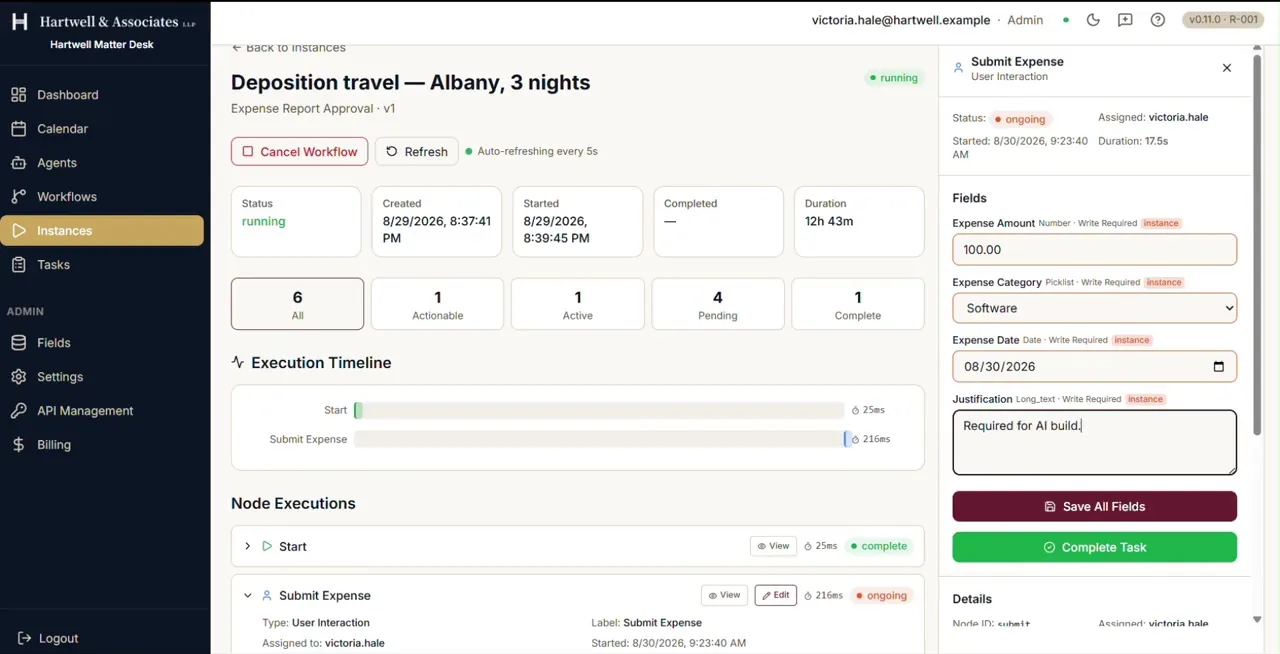
A running instance with one of its steps open in a side panel. The panel is headed Submit Expense, marked a user interaction, ongoing, and assigned to victoria.hale. Its fields hold an expense amount, a category, a date and a justification, each marked write required, over Save All Fields and Complete Task buttons. Behind it the instance shows its status tiles, its step counters and an execution timeline.
Step two: the review and input steps become a form, assigned to a named person. Demo workspace with example data.

Watching a run

Every instance keeps its own timeline, so you can see which step it is on and how long each one took.

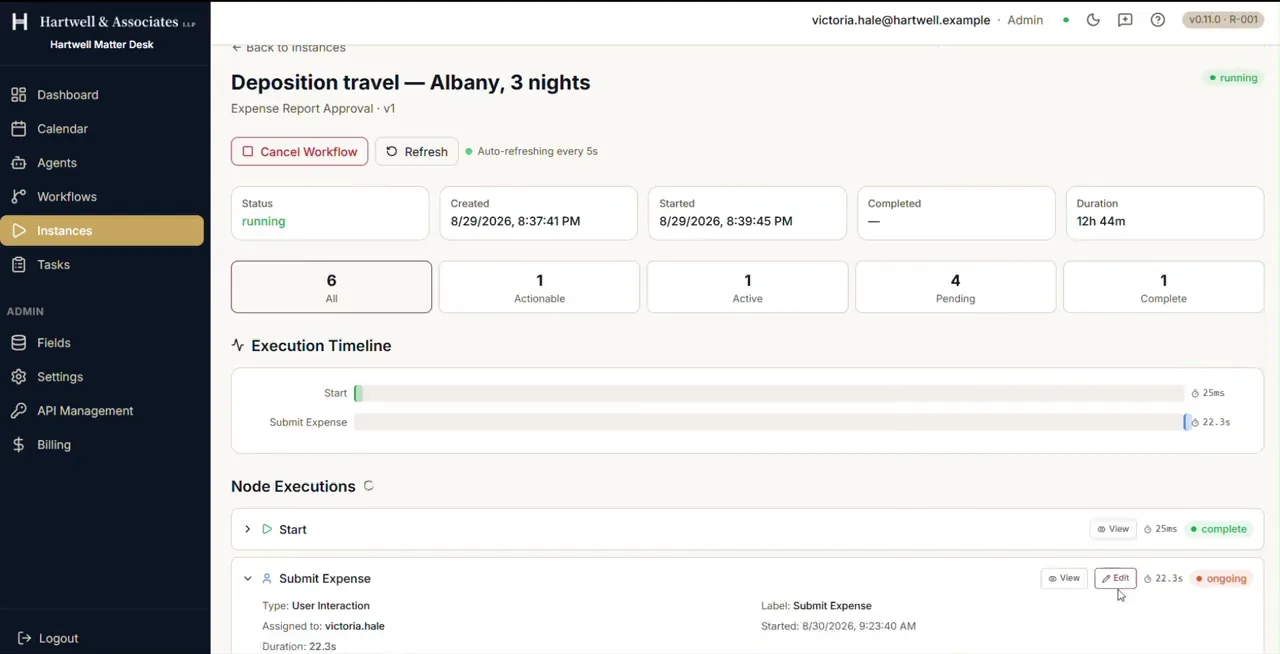
The detail view of a running workflow instance of Expense Report Approval. Tiles show its status as running, when it was created and started, an empty completed field and a duration of twelve hours and forty three minutes. Counters below read six steps in all, one actionable, one active, four pending and one complete. Under them an execution timeline plots Start and Submit Expense with the time each took, over a Node Executions list showing Start complete and Submit Expense ongoing, assigned to victoria.hale.
Step three: every run is inspectable node by node. Demo workspace with example data.

What the timeline is actually made of

Under the timeline sits every node execution in order, each one carrying its own state, so a run that has stopped tells you exactly where and why.

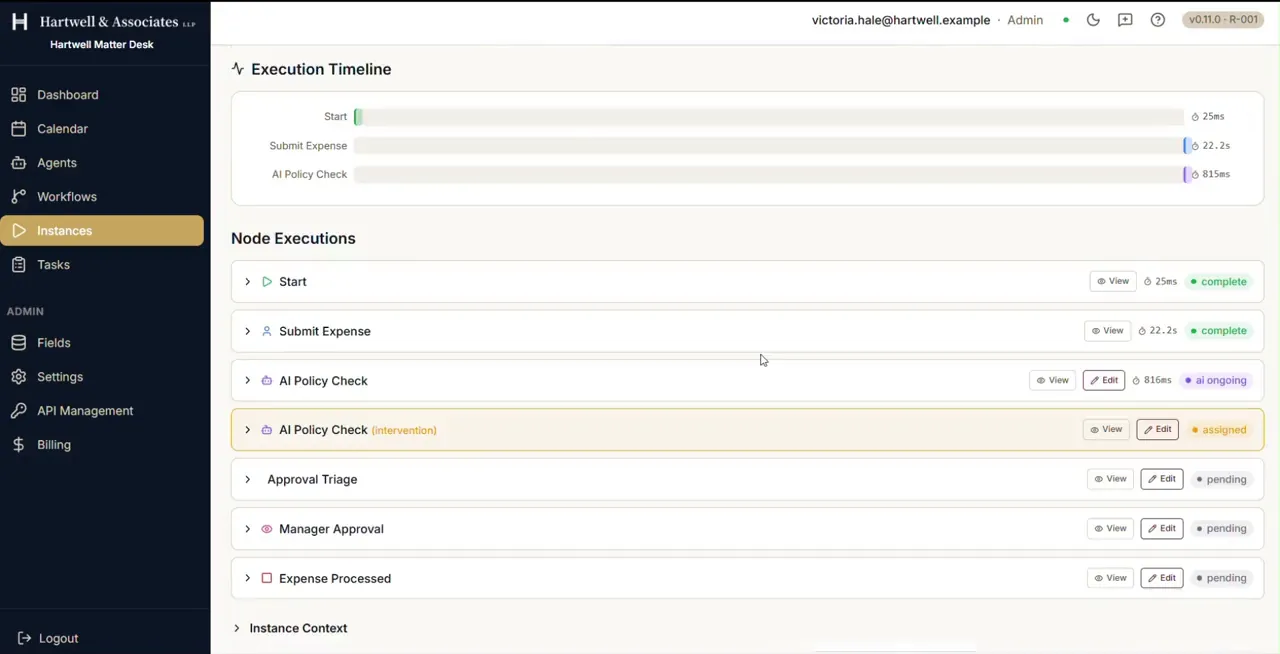
The Node Executions list of a running instance, with an execution timeline above it plotting Start, Submit Expense and an AI Policy Check. The list reads Start complete, Submit Expense complete, an AI Policy Check marked ai ongoing, then a second AI Policy Check row labelled intervention and marked assigned, and finally Approval Triage, Manager Approval and Expense Processed all pending. Every row offers a View button and most also an Edit button.
One run, node by node. The second AI Policy Check row is an intervention: the agent's retries ran out, so the engine raised a step for a person instead of dropping the run. Demo workspace with example data.

Inside one node

Every node on the canvas opens its own settings: who it is assigned to, whether it notifies anyone, and the paths out of it.

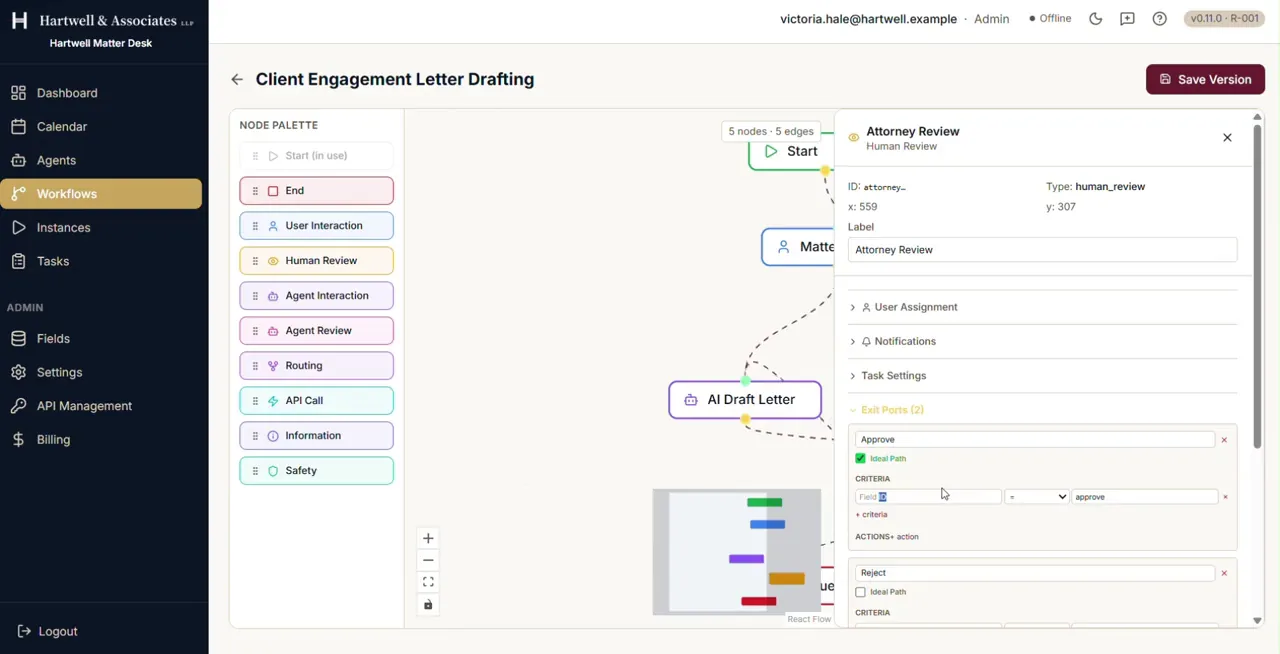
The workflow designer with one node's settings open in a side panel. The node is named Attorney Review and typed human review, and carries its own id and canvas position. Collapsed sections offer User Assignment, Notifications and Task Settings, and an open Exit Ports section defines two ports, Approve and Reject, each with an ideal path checkbox and its own criteria and actions rows. The canvas behind shows Start connecting through Matter Details to AI Draft Letter.
One node's settings, and the two named exits that decide where a run goes next. Demo workspace with example data.

Putting a run on the calendar

Step three of the five above, in real time: pick the workflow, name the run, choose one-time or recurring, and set the cadence.

Scheduling a run from the calendar in the Hartwell demo workspace, which is example data, in month and week views.

Can an AI assistant build a workflow in Dave?

Yes, over MCP. You create a registration under Admin, API Management, MCP, choose the capabilities it gets, and paste the config Dave generates into Claude Code, Claude Desktop, VS Code or a JetBrains IDE. On the Builder preset the assistant can list and open workflows, create and modify them, publish a version and activate it, and create and update the agents those workflows call. Dave hosts the MCP server, so the client connects over HTTPS with no local process to keep running.

Building with an assistant, over MCP

MCP is the open standard AI clients use to talk to other systems. Point one at your workspace and it works inside the limits you set, on the tools you granted it.

Set it up once, in the admin UI

Go to Admin, API Management, MCP, then New Registration. Name it for what the connection is for, pick a preset, fine-tune the capabilities, and optionally set an expiry date. Dave then generates a ready-to-paste config for your client. The key is shown at that moment and never again: it is stored hashed, so a lost key is replaced by rotating it rather than looked up.

Read the setup guide

It can build, not just read

The workflow tools cover listing workflows, viewing one, creating one, publishing a version, activating it and deactivating it. The agent tools cover listing, viewing, creating and updating agents, so a workflow and the agents it calls can both be built in the same conversation.

Guide: Create a workflow

And it can run the work too

Instance tools list and view runs, create and trigger them, set field values, start and cancel them, read execution context and assign roles. Task tools list and view tasks, reassign them, and submit a decision: approve, reject, or request changes.

Guide: Launch an instance

Four presets, and the narrowest one wins

Observer can only look. Operator adds launching instances, setting field values, completing tasks and reading artifacts. Builder adds creating and modifying workflows, publishing and activating versions, and managing agents. Full adds audit and execution-event access. Presets are starting points you can adjust capability by capability, and no MCP key receives blanket administrator access.

The limits are enforced, not just displayed

Each capability maps to a specific backend permission that the server checks on every request, so a key cannot reach data or actions outside its capabilities even by calling the API directly. Responses are stripped of sensitive values as well: passwords, key hashes, tokens and client secrets are never returned to the assistant.

Everything it does is in the audit log

Work done through an integration is recorded alongside work done by people and attributed to the integration by name. Each registration also records when its key was last used, so connections nobody needs any more are easy to spot and revoke.

Where MCP connections live

A registration is a credential, so it sits with the rest of them under API Management.

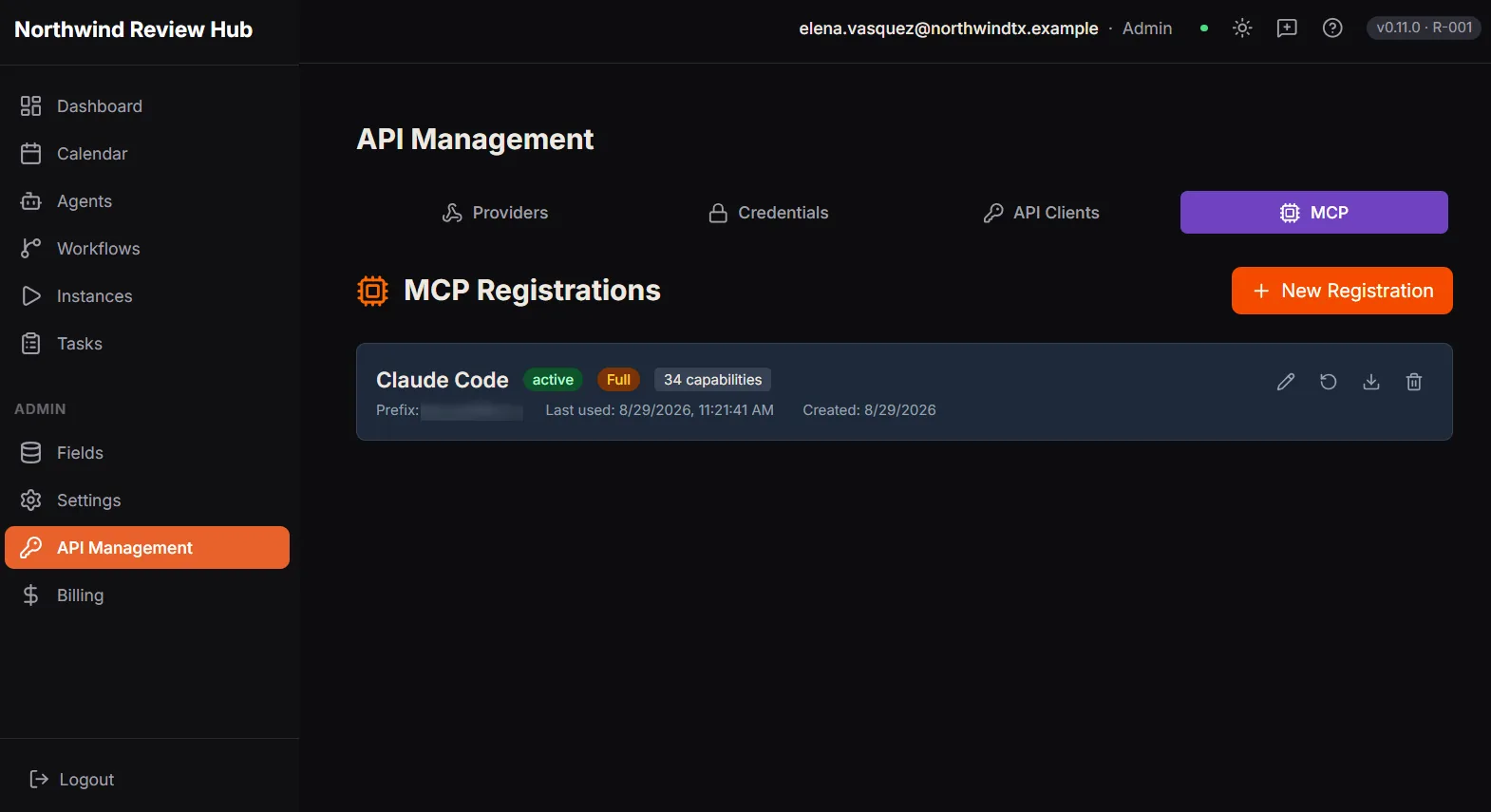
The API Management screen on its MCP tab, listing one registration named Claude Code. It is marked active, carries the Full preset and thirty-four capabilities, and shows a key prefix, when it was last used and when it was created. Further tabs cover Providers, Credentials and API Clients.
One MCP registration, with its preset, capability count and last use. Demo workspace with example data.

Frequently asked questions

Do I need to write code to build a workflow?

No. Dave is a visual, drag-and-drop builder. You compose workflows from nodes and connect them with routing rules, including calling external APIs, with no code required.

Can workflows loop or branch?

Yes. Edges carry conditions evaluated at runtime, so flows can branch, merge, and loop back to earlier steps, for example a reject-and-rework cycle, with safety bounds to prevent runaway execution.

What happens when an AI step fails?

Each agent node supports 1 to 10 configurable retries. If they're exhausted, the engine creates a human intervention node so a person decides what happens next: no workflow is ever silently lost.

How are workflow versions handled?

Every save creates a new version, and previous versions are retained for rollback and audit. Running instances always use the current version automatically.

Can a workflow call my other systems?

Yes. An API Call node can make GET, POST, PUT, PATCH, or DELETE requests to any REST endpoint mid-workflow, using credentials from the vault and mapping the response back into workflow fields.

Who on my team can build workflows?

The workflow editor opens for the Admin and Curate roles, and those are also the roles that can create a workflow and move it from draft to active. Building agents is the Create role's job, and Curate can read agents so it can reference them on a node. One person can hold more than one role, so a small team often gives the same account both.

Does the workflow editor save automatically?

No, and that is deliberate. Nothing is persisted until you click Save Version, and each click writes a new immutable version rather than overwriting the last one. Nodes and edges you delete disappear from the canvas straight away but are only really gone once you save, and navigating away without saving discards the changes with no prompt.

See it in action.

Configure your first agent and launch a workflow today.

How It Works: Configure AI Workflows in Minutes | Dave